Rent-to-own around the world

Rent-to-Own: How a Proven Global Model Could Help More People in Ireland
In Ireland, the average house price now exceeds €340,000 nationally and €450,000 in our capital city. For the mass of people trapped in a rental market that consumes the majority of their income, saving a deposit whilst paying rent has become a near-impossible task. The path to homeownership is struggling to serve a generation of would-be buyers.
The rent-to-own solution isn’t new. It has been operating in various forms globally for decades.
The rent-to-own (or rent-to-buy) model is employed in many jurisdictions, with some models dating as far back as the 1950s and 1960s, re-emerging with renewed purpose following the 2008 financial crisis as an alternative for those unable to secure a conventional mortgage. Today, governments and private operators across Europe, North America and beyond have developed a wide spectrum of frameworks, each tailored to local market conditions, but all united by a common purpose: bridging the gap between renting and owning.
Here’s how some of those models look around the world, and why Ireland needs one of its own.
France: A State Supported, Incentivised Framework
France operates one of Europe’s most developed rent-to-own markets through a state supported model known as PSLA (Prêt Social Location-Accession). Under the PSLA model, tenants occupy a property during an initial jouissance phase, in which they pay below-market rent before exercising the purchase option to acquire the property at a pre-agreed price. PSLA properties attract a reduced VAT rate of 5.5% (compared to the standard rate of 20%) and are exempt from property tax (taxe foncière) for 15 years. These benefits are passed on to the buyer, making ownership meaningfully more accessible. The model also provides strong consumer protections, ensuring public trust and long-term viability.
The US, Canada and the UAE: Flexible but Fragmented
In the US, Canada and the UAE, rent-to-own models typically take the form of lease agreements with embedded purchase options. Unlike the French model, these are not uniform at a national level. In the US, frameworks vary considerably by state. Similarly in Canada, frameworks differ by province. In the UAE, particularly in Dubai, the model is largely developer-driven, with developers structuring rent-to-own schemes primarily as a sales mechanism.
Germany: A Cultural Counterpoint
Germany, despite having rent-to-own structures such as Optionskauf, Mietkauf, and Bausparvertrag, has not witnessed mainstream uptake. The reason is largely cultural. Germany has one of the lowest homeownership rates in the developed world, sitting at approximately 45% compared to an EU average of 70%. It is, traditionally and by preference, a renter nation, supported by strong tenant protections and a well-regulated private rental sector. The rent-to-own models exist, but the demand to use them has simply been lower than elsewhere. This is an important reminder that no single model works everywhere — cultural context and market conditions matter, and any effective rent-to-own framework must be designed for the society it serves.
Shared Equity and Shared Ownership: Adjacent Approaches
Several countries have approached the affordability gap differently through shared equity or shared ownership frameworks, which sit adjacent to but distinct from traditional rent-to-own models.
In the UK, the government’s shared ownership scheme allows buyers, typically first-time buyers, to purchase a share of a property (10–75%) and pay subsidised rent on the remaining portion. Over time, ownership can be increased through a process known as staircasing until the property is owned outright. A number of private-sector rent-to-own operators also exist alongside these government-backed schemes.
New Zealand offers a five-year rent-to-own programme through the New Zealand Housing Foundation, with providers receiving interest-free government loans to fund the acquisition of properties. Participants pay market rent during the term before purchasing the property at market value, assessed by an independent valuer. These schemes are income-capped and serve the squeezed middle — those who earn too much for social housing but not enough to purchase on the open market.
The Australian market features both rent-to-own models and shared equity schemes, which vary by state. The federal government’s Help to Buy scheme allows eligible buyers to co-purchase a home with the government taking a 30–40% equity stake, reducing the deposit and mortgage burden on the buyer. The government’s share is recouped upon sale of the property.
Denmark: A Community-Centric Alternative
Denmark has created a distinctive alternative through its cooperative housing model, Andelsboliger. Approximately 7% of the Danish population, or roughly 400,000 households, currently live in cooperative housing — a model that has been embedded in Danish society since the 1970s. Under the Andelsboliger model, homeowners purchase a share of the cooperative that collectively owns the properties and common areas of a co-owned estate, with monthly fees covering maintenance and running costs. This model promotes a more inclusive and community-centric approach to housing, and since its inception, prices have remained relatively stable, keeping housing affordable and accessible even for those earning below the median income.
So, Why Does Ireland Need This?
Ireland’s housing crisis is well-documented. According to the CSO, property prices have increased by over 90% since 2013. Mortgage rejection rates remain elevated, particularly for younger and self-employed buyers. The Central Bank’s deposit requirements mean that even those with strong incomes face years of saving before they can realistically think about buying a home.
Meanwhile, the private rental sector offers little security and consumes an average of 30–35% of household incomes in urban areas. In many parts of the country, particularly outside the larger cities, there is very little available to rent at all. The state spends a large amount of money on rental and housing supports (HAP) which could be paired with a rent-to-own offering to make ownership a realistic opportunity and incentivise recipients to strive to own.
The consequences of this divide are stark. The average net private wealth of homeowners is in the hundreds of thousands, while the net wealth of a renter is typically in the single-digit thousands. Those who can’t secure a mortgage often end up paying double what a typical mortgage repayment would be for an equivalent — or worse — property, with no capital appreciation to show for it. Of course, prevailing conditions can change. If prices fall, relative positions can shift quickly; in the UK currently, it is more expensive to own than to rent, with mortgage rates running above 5% and property prices under pressure.
At present, there is no mainstream rent-to-own framework in Ireland. Between renting and owning, there is nothing in the middle — unless you live with parents or qualify for social supports. That is a significant gap, and one that Homely is working to close.
Where Homely Comes In
The Homely model draws on some of the best elements of the frameworks employed in France, the UK and New Zealand. Customers apply, choose a home they wish to live in, and move in as tenants paying market rent. Over a three-to-five-year period, they accumulate rental and value discounts that recognise their commitment towards the final purchase price.
The model is designed to serve the squeezed middle — people who are creditworthy, motivated and capable of ownership, but who simply haven’t yet been able to bridge the gap between renting and buying. At the same time, Homely helps unlock new supply and adds tenancies to the market where the crisis is most acute.
Homely is at an exciting stage of growth and is actively working to expand our portfolio and reach to provide the rent-to-own solution at scale across the country. We are actively seeking partnerships with developers and capital partners who see the opportunity — and the responsibility — to make a lasting difference in the Irish housing market.
If that sounds like you, we would love to have a conversation.
info@ownhomely.com | ownhomely.com
#Homely #RentToOwn #IrishHousing #Proptech #IrishProperty
Further Reading
- Rent-to-Own Real Estate: Access to Homeownership in France
- Cooperative Housing — World Green Building Council
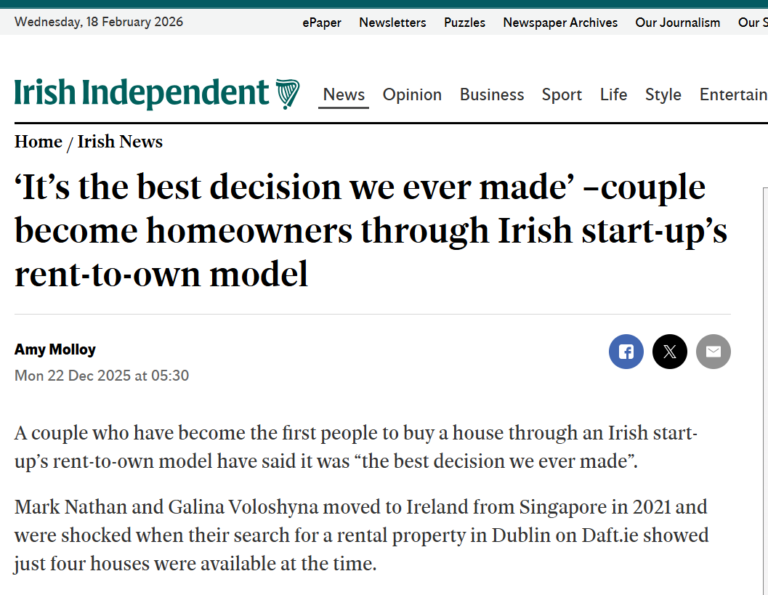
- Couple Become Homeowners Through Irish Start-Up’s Rent-to-Own Model — Irish Independent
- Explained: What Is Denmark’s Cooperative Housing System — The Local
- Australian Government Help to Buy Scheme
- How Rent-to-Buy Works in Australia — Aussie
Stay tuned for more updates and initiatives as we continue to expand our reach and services, all with the goal of helping more people across the country achieve their dreams of owning their own homes.